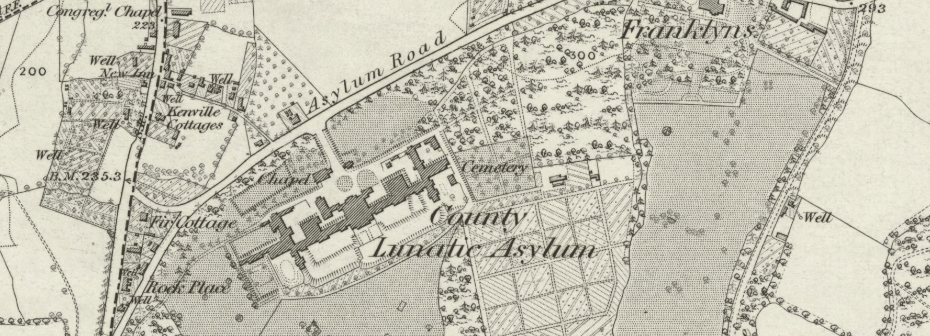
All our stories are about mental health patients who died in the Sussex County Asylum in Haywards Heath, Sussex between the years of 1860 and 1953, the years during which the Asylum burial grounds were used. In 1953 the cemetery was closed for further burials. Like all the UK County Asylums this institution had several name changes over the years and was eventually (1948) named St. Francis Hospital. It will be referred to from now on in this section as St. Francis Hospital.
When patients died in the hospital their named next of kin was informed and given a period to claim the body for disposal in the place of their choice. If the next of kin did not respond, could not be found or declined the opportunity to dispose of the body, the body was buried in the hospital burial ground, unnamed and with very limited marking, usually just a grave number. There are just under 4,000 such burials in the St. Francis Hospital burial ground which can be located today about 200 metres north west of the main car park nearest the main entrance to the Princess Royal Hospital, Haywards Heath, Sussex. There is currently no indication that this burial ground and its 4,000 residents are there.
Unless stated otherwise in the story text every one of our stories is based on the information in a single entry of almost 4,000 such entries in the Sussex Asylum (eventually named St. Francis Hospital) burial record books. Each entry is the record of the burial of one person. There are usually eight entries on each page of the burial, here is an example of a page layout.
our latest stories
- Dubbin, George Aquila
- Pyner, Clara Emily
- Emery, Churcher Clayton
- Gasson, Sophia
- Chennery, Abraham
- Baum, Bertram & Bernard
- Casselden, William
- Sopp, Edmund
- Siffleet, Silas
- Braby(nee Davis), Jane

How are our stories researched and written?
Every one of these burial record entries has been transcribed by project volunteers in to a MS Excel spreadsheet. (We express sincere thanks to Karen Tayler who did an outstanding job transcribing about half of these records.) During the transcription of each record into the spreadsheet the spelling of the Name, the Age and the Burial Date were checked for accuracy using FREEBMD.ORG.UK. Discrepancies have been noted by the transcriber into a MS Excel note in the relevant column for the entry and the information in the Note has been given to the volunteer genealogical researcher for this particular story. This is one of the ways we try and keep our focus on accuracy of information.
As stated earlier each detail line on the burial register page contains the information that a researcher is given to start their research on the named individual. Each line consists of:
- Name
- Previous Place of Abode (before admission to the County Asylum)
- When Buried (day number and month name, the year is stated at the top of each page or in a handwritten note in the body of the page)
- Age (in years, but for babies it might be written in days or months)
- By Whom the Ceremony was Performed (the name of the person who conducted the burial service, this information is rarely used by the researcher)
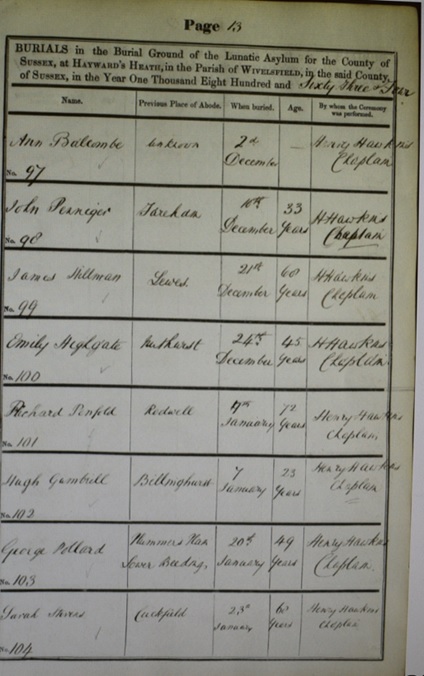
So the researcher has four pieces of information to start their research plus the name of the County Asylum in which the person died and the Registration District in which the person’s death was registered (Up until midway through 1934 all the patient deaths at St. Francis Hospital were registered in the Registration District of Lewes, then from midway through 1934 the Registration District for deaths became Cuckfield). These few pieces of information are not very much for a researcher to be able to start their work of bringing somebody “back to life” by researching and writing their story. However, our researchers support each other on this project and have learned many of the intricacies of recreating the lives of people who died in the UK County Asylums from the research done on Horton Cemetery (a similar but larger cemetery) in Epsom, Surrey. Horton Cemetery was used to bury the unclaimed dead from the five London County Asylums that functioned in Epsom from 1899 to the late 20th century. You can read the stories created by the charity, the Friends of Horton Cemetery researchers here https://hortoncemetery.org/the-people/horton-cemetery-stories/ .
The researchers are given a list of entries from the burial records to research and each of our researchers has complete control over how many people they have on their list. As they progress through their list they can request more names, or take a break, it’s a matter of their choice. Each researcher has complete freedom to use the tools (genealogy apps, government records, newspaper archive apps, geography and mapping apps, local records and archives, archived hospital records etc. etc) of their choice to research and create the building blocks of their story. We prefer them to use one of a limited range of word processing applications so that the review and publication processes are simple and efficient. The range of acceptable word processors is currently MS Word, LIBRE OFFICE Write and Apple Pages.
Our researchers are given some project specific guidance to help them with their research. We do have not have a strict set of rules and regulations and each researcher is encouraged to use their own writing style when writing their story. We have only two rules really: a) the story should be written in chronological order b) any fact stated in the story must have accompanying proof in a separate document that we call a Trace record. (It is the Trace record that enables the story to go through the review process as efficiently as possible.) We view the volunteer who has researched and written the story as the “emotional owner” of the person and their story. In a sense each of our volunteers is a sort of “midwife” who will bring their subject “back into this world” and present them to the world and perhaps to relatives who are alive today who may not have known that the person (or even people) in the story ever existed. We encourage our researchers to focus their story on the person in the burial record, who died in St. Francis Hospital, was unclaimed on death and was buried in the hospital cemetery. Obviously, the person’s story is partly defined by their immediate family members, but it is very easy to get pulled away from the focal person of the story if they have a relative who became a world famous film star, famous politician, author, hero etc. We hope that through these stories our readers will learn something about real people (as opposed to, for example, characters in novels) and their lives and the lives of their family members in (mostly) Sussex from the 19th century and into the 20th century. We also hope that our readers, through these stories, will begin to appreciate that having mental health problems or learning difficulties can happen to anyone.
We encourage (we don’t command) our researchers to add a short chapter at the end of the story they write titled something like Author’s Thoughts. In this chapter our researcher is free to write their own feelings about the story, they can express doubt, anger, frustration, pity, joy, sympathy etc. They can express conjecture, they can ask questions, they can express doubt and uncertainty. In this way we hope that our researchers show some of the emotions they have experienced during their work on the story and that this might help you better understand and appreciate the stories. Our volunteer researchers are not reporters, they are story tellers and the stories that they tell are true stories, about real people who have suffered the pain and anguish of mental health problems and learning difficulties. Their family members have seen their suffering (not always perceived as such) and have probably shared this suffering. When you read our stories the pain, suffering, anguish, sorrow of the people living the story may not be obvious. Much of it is “between the lines”, some of it will be brought out to you through the contents of the “Author’s Thoughts” chapter, but you, our readers must try and discover it, sense it, for yourselves.
Once a story has been completed by a researcher the story and its Trace record will be reviewed by another volunteer researcher. The review process is a cooperative exercise between the story writer and the reviewer to ensure that the contents of the story are accurate, that the story is comprehensible and that any typos etc. are corrected. It must never be a reviewer’s ego trip or exercise in humiliation or superiority. The story writer’s writing style is sacrosanct. If any additional information is discovered during the process of the review a discussion takes place between the writer and the reviewer as to whether the additional information is necessary and will add some essential element to the story. Common sense is used a lot in a review. Once the story writer and reviewer have agreed on the final version of the story it is sent for publication.
Publication of the story is simply a process of adding a standard heading to the story and any meta data or tags that will help in story searching or story metrics post publication. The publication of the story will not change the story itself unless the person doing the publishing suddenly discovers an error. In this case the publication process will stop and the story will go back to the story writer (“emotional owner” of the story) and the reviewer to make and review the change. Common sense will prevail if the error that has been spotted only requires a very simple change (e.g. a misspelling) and in this case the story writer will allow the publication person to make the change. The story writer will also reflect the change in the version of the story that they have stored thus keeping both things in sync.
An Ongoing Process
At some stage we will link the project to social media applications such as Facebook and Instagram.
Experience with the Horton Cemetery Research project (based on Horton Cemetery in Epsom, mentioned earlier in this chapter) has shown us that eventually it will be possible to add new information to published stories. This Epsom project is now the engine room of the charity The Friends of Horton Cemetery. In addition, over time, new information becomes available in genealogical research apps such as Ancestry and Find My Past when further records are discovered, transcribed and made available. Also new hospital archive records can become available over time in the County Archives and sometimes story readers, who are relatives of the people in the stories, contact the project to enable new information to be added to previously published stories. We will update already published stories when this happens, and we will try to arrange that the original researcher and reviewer work together to add this new information to these stories.
We know that our stories can never be perfect. Only the people who lived these lives and the people who lived with them prior to their admission to St. Francis Hospital could tell us the perfect stories. But in this community project we feel that it is very important to do the best that we can to show the world that these people, who were anonymised after their death in a Sussex County Asylum and buried without their name and with minimal, if any, marking, should not be allowed to disappear. We have all volunteered to work on this project for them, to tell their stories for the sake of their family members living today, for their family members of the future, to learn more about the social history of Sussex, to show that all people matter and have a story and that mental health problems can happen to anyone.
We are human beings trying to right a wrong – nobody should be made to disappear. We write the stories of yesterday through the lens of today and our own life experiences. Sometimes we are going to get things wrong. If find errors, especially factual errors in our stories please get in touch with us and let us know. Go to our Contact page to learn how to do this.
Our project will follow the convention that prevents us publishing stories for people who have been dead for less than one hundred years. This means that as each year passes, we will be able to research, write and publish the story of more people. Occasionally, as has happened with the Horton Cemetery project, we may be given stories or partial stories by family members of patients who are buried in the St. Francis cemetery less than 100 years from the current year. We can fully research and publish these new stories as long as the family of the person gives us their written (electronically written is fine) permission.
 Sussex Asylums Burial Grounds Project