Author: Linda Miles-Cartwright
Edward Coote
Born: 1779
Died: 7th April 1865
Buried: 11th April 1865
Edward: The Tale of a Shepherd
Edward was born around 1779 when King George III was on the throne of England. The country was under threat of invasion from the French and the Spanish, and the world’s first cast-iron bridge had been erected in Shropshire. Edward would have seen changes in the world around him in his 80 plus years. But let’s start at the beginning.
Early Days
Edward was baptised on 24th October 1779, alongside his sibling Richard at Folkington in rural Sussex. His parents were George and Ann Coote. Some Ancestry trees suggest that Edward’s mother was of Norwegian extraction and her parents were Ole Olsen Moen and Ane Hansdatter. There is a marriage that took place between George Coote and Anne Money on 20th April 1768 from the parish of Rackham which could be them.
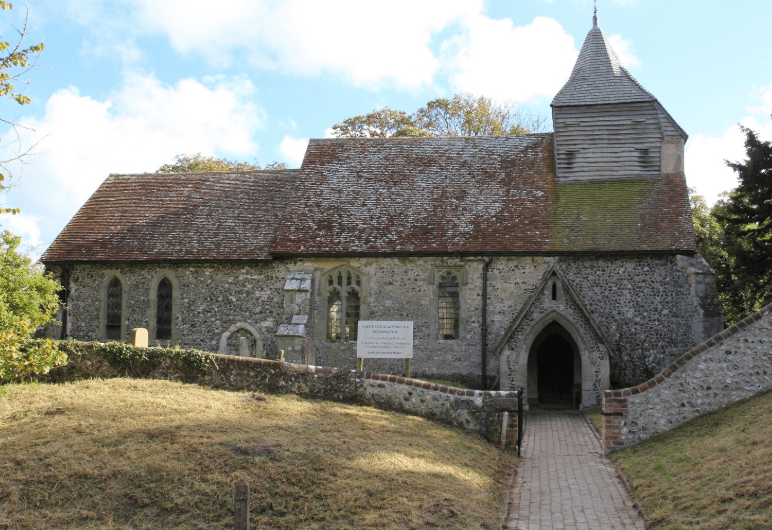
Folkington is a small village approximately 4 miles from Eastbourne, set in a valley. Most of the village was centred around Folkington Manor with a 13th century church where Edward and his siblings were baptised. It was, and still is, a rural community.
Below is St Peters church in Folkington, where Edward and his siblings were baptised.
Edward was brought up with his siblings: his older sister Sarah, and younger brothers Richard and George. His mother Ann died in 1787 when Edward was around 7 years old. There may have been an older brother called John born in 1768. Edward’s father George was probably an agricultural labourer.
Marriage
Edward married Sophia Bonniface on 28th November 1809 in the village of Hellingly in Sussex. Her parents were John and Charity Bonniface.
Edward’s bride appears to have been born around 1790 in the Hailsham area. She came from a large family of 11 children, a family of people who worked on the land. Ancestry family trees suggest that John and Charity were first cousins descending from Thomas and Elizabeth Bonniface.
A growing family
Edward and Sophia’s children were born before registration was introduced, so births have been tracked down using Baptism records supported by the 1841 Census return. They appear to have had 13 children.
| Birth year | Name | Baptism date | Church | Abode | Fathers Occupation |
| 1810 | Richard | 01/07/1810 | Hailsham | ||
| 1811 | George | 09/02/1812 | Hailsham | ||
| 1813 | Edward | 21/03/1813 | East Hoathley | Rackham | Lab |
| 1814 | William | 03/07/1814 | East Hoathley | Shepherd | |
| 1816 | Edwin | 25/08/1816 | East Hoathley | Shepherd | |
| 1817 | Mary | 14/03/1819 | Amberley | Rackham | Lab |
| 1819 | Jane | 14/03/1819 | Amberley | Rackham | Lab |
| 1821 | Sophia | 01/07/1821 | Ore | St Mary Magdalene | Shepherd |
| 1823 | Albin | 04/05/1823 | Ore | St M M | Shepherd |
| 1824 | John | 02/05/1824 | Ore | St M M | Shepherd |
| 1827 | Harriet | 01/04/1827 | Ore | St M M | Shepherd |
| 1829 | Frances | 11/10/1829 | Hollington | St M M | Lab |
| 1832 | Alfred | No records |
The baptism records help to trace where the family lived and the nature of their father’s occupation. Edward was employed as a Shepherd predominantly in the South Downs area.
The life of a Shepherd
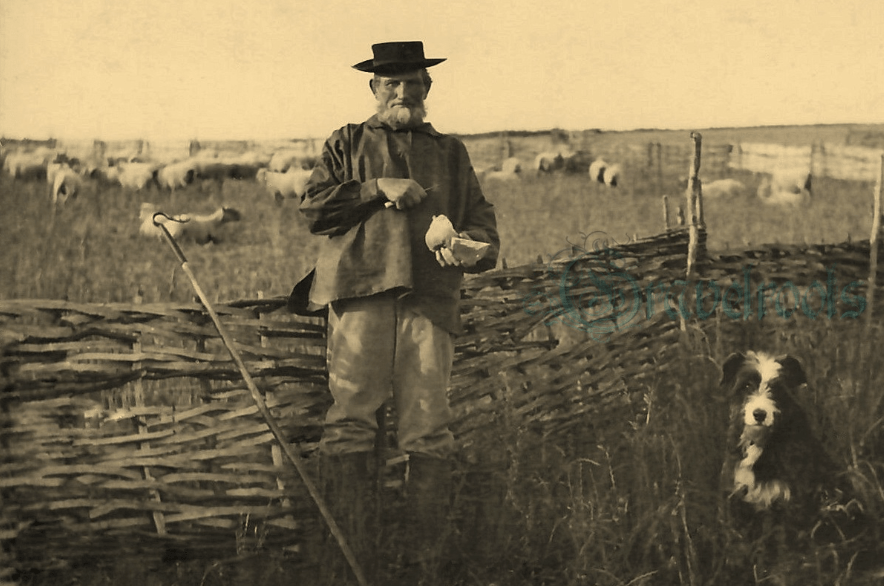
In those days it was normal that Shepherding was handed down father to son, which suggests that Edward’s father may have been a Shepherd too. Perhaps from a very early age Edward helped his father with the sheep, and it became his calling in life. It would have been a hard existence, working outside in all weathers, but something Edward would have accepted as his lot. At this time Edward may have lived in a Shepherd’s hut for part of the year. This was for shelter and to keep an eye on the flock, especially during lambing. It was a solitary job, often with only a sheep dog for company. He would have had a cottage provided with his job and certainly he would have needed it with the size of his growing family. This photograph of a Sussex Shepherd, albeit from a later time, gives us some idea of how Edward would have dressed.
.
1830s
The 1830s saw Edward’s children leaving home and marrying.
Richard was married by Banns in Hailsham to Harriet Taylor on 8th December 1834.
Edward junior married Sarah Roper in Ore on 23rd February 1835.
Mary married George Burgess on 17th May 1838 at St Leonards.
Sophia married John Brook in Amberley on 10th January 1840. The wedding was by licence, and Edward gave his consent as the bride was not of age.
1841 Census
The family were living at Spittleman’s Down in the parish of St Mary Magdalen, in the sub registration district of St Mary in the Castle in Hastings. This area is now known as Bohemia on the west side of town. Notes from a Hastings Bygones publication suggest there was an early Norman hospital here that became known as Spittleman’s (i.e. hospital man’s) Down, and the land originally belonged to the Magdalen charity. By Edward’s time, slivers of land were being sold for housing as Hastings expanded. It was still a relatively rural area for a while. From an article printed many years later, and from the baptisms of his children, it seems as if Edward and his family moved here as early as the 1830s.
The household was recorded as Edward Coote: aged 55 an Agricultural Labourer, Sophia (his wife) aged 45, sons William aged 20 and John aged 15, daughter Harriet aged 14, and son Francis aged 12. There were two further children: Alfred aged 9 and Caroline aged 5. Caroline, their Grandchild, was aged 1.
On 27th November 1843, the couple’s eldest daughter Jane married William Spice at St Leonard’s Church. There is no evidence to suggest that Edward and Sophia attended the wedding.
The 1845 Electoral Register records Edward still living at Spittleman’s Down.
18th November 1846 saw the marriage of Harriett Coote to Thomas Clarke at St Leonard’s Church.
Move to Rackham in West Sussex
At some point Edward and Sophia seem to have moved back to Rackham, leaving their family in Hastings. Their youngest child Alfred was around 14 or 15 years old and there is no evidence that any of them followed their parents to Rackham.
Edward and Sophia had lived in the area before, and Edward’s niece Jemima and her family were living in Amberley. Perhaps they sought a quieter life, as Hastings had now grown into a large bustling town with a population of around 9,500. We shall never know for sure.
It is not clear how Edward ended up in Thakeham Union Workhouse, but he obviously felt unsettled there, as the Newspaper below reports. The article states that he comes from Rockham, but this is more likely to be the parish of Rackham. His later admission records to Sussex Asylum explain why he was in the Workhouse.
Sussex Advertiser dated 13th November 1849
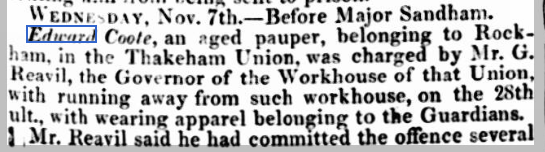

By today’s standards this seems very harsh treatment for an elderly man clearly needing support.
Edward would be dealt another blow when, on 9th May 1850, Sophia died aged 62 at Thakeham Union Workhouse. The cause of death was listed as ‘Rheumatism’ and a ‘Diseased Heart’. She was buried in Amberley churchyard on 13th May 1850.
1851 Census
The Census of 1851 revealed that Edward was back in Thakeham Workhouse. Aged 72 and a widower. He is described as “formerly a Shepherd”, which suggests he is unable to work.
Thakeham Workhouse
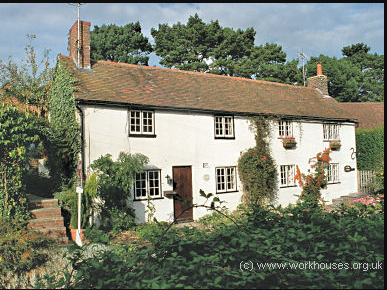
Edward’s condition was obviously deteriorating, and decisions had to be made. There appears to have been a medical examination made 21st November 1851 which stated he had dementia caused by “Morbid sensibility of the generative organs.”
What to do with Edward?
At this point it must have been clear that Edward was not improving, and he had proved to be quite a handful when previously an inmate. At the time there was no County Asylum in Sussex, and each parish was responsible for the welfare of their own poor. Mental illness was not seen as a medical issue but as a poor relief problem. So what options were available to the authorities?
The cheapest option would have been to keep Edward in the workhouse, but he had proved that wouldn’t be possible. Secondly, could he be boarded within the community? This was probably not an option in this case. The third option was to send Edward to a “private madhouse”, as they were called in those days. This was the most expensive option, but certain institutions such as Bethnal House in London offered a discounted rate if patients went there in large numbers. The Parish Officials would have been keen to remove a patient like Edward as they were under pressure to keep order. All that was needed was a medical certificate from any local doctor and an order from a parish official. Once certified, a patient could be removed in hours. Hence, the medical certificate for Edward, which was signed by Frederick Davies on 21st November 1851. The certificate gave a simple medical diagnosis: “Dementia”.
This had a very different meaning to the modern medical meaning of dementia. It was not a specific disease but a catch-all term for anyone who showed confusion, memory loss, disorientation, or lack of reasoning. It could have been as simple as an inability to work or care for themselves or a decline with age. It basically meant mental decay.
The decision was made to send Edward to Bethnal House Asylum in London.
Edward’s journey to Bethnal House
Edward would have been escorted by one of the parish officials, possibly with a constable, and transported to the nearest railway station. From there, he was sent to London and delivered into the care of Bethnal House.
Even by the standards of the time, Bethnal House had poor conditions, which included overcrowding and neglect. In 1851 the Asylum accommodated 558 patients and 56 members of staff. There were reports of insufficient staff, little supervision, few attempts to treat anyone, and unclean bedding and clothing.
For Edward, who would have been used to the wide-open spaces of the Sussex countryside, this must have been terrifying. His daily life would have consisted of being locked into a communal ward with very poor food. There were long periods of idleness, with only occasional time outside in a walled yard. Edward may even have been restrained from time to time. Although discouraged by 1851, restraints were still being used – especially on pauper inmates. If you were noisy, violent, or distressed, you were likely to be restrained.
A move to the new County Asylum
I tracked down the Lunacy Register entry, which shows Edward was admitted to Bethnal House on 24th November 1851. He stayed there until 28th July 1859 when he was transferred to Sussex County Asylum, as their Admission Records confirm.
After 8 years of living an unbearable life in Bethnal House, things did improve for Edward when he was admitted to the new Sussex County Lunatic Asylum; he was the 53rd admission. The first patient had arrived on 25th July 1859.
Edward was recorded as being around 70 years of age when his health problems first occurred, and he was also very deaf. By the time of his admission, he was 80 years old.
Sussex County Lunatic Asylum, newly opened in 1859, was originally for pauper lunatics. Its first medical superintendent was Charles Lockhart Robertson, and he was one of the most progressive men in this field at that time.
Charles believed in progressive treatment. At the heart of this was fresh air, productive work, a good diet, and healthy exercise. How much of this Edward could enjoy is questionable. However, one hopes that, as a man who spent all his working life outside, he could at least enjoy fresh air and good food again. Edward was fortunate to be at the Asylum when such kind treatments prevailed.
The 1861 Census shows him still living at the County Asylum. He is recorded only by his initials, his previous occupation as a Shepherd, and the fact he is deaf.
Edward was an elderly man with a broad diagnosis of dementia, which meant there was no cure despite all the best intentions. After nearly 6 years at Sussex Asylum. Edward died there on 7th April 1865. His cause of death was listed as “Senile Decay”. He had spent the last 14 years of his life in care. He was 86 years old.
Edward was buried in the Asylum’s burial grounds on 11th April 1865.
Edward and Sophia’s Children
I have dealt with Edward’s children only briefly, so as not to detract from Edward’s story.
Richard
Richard was born in 1810 and, as we have seen, married Harriet Taylor in 1834. They went on to have 4 children and lived in Hastings where Richard worked as a Porter for a Coal Merchant. Richard died in 1869 aged only 59.
George
George was born in 1811. He never married and worked all his life as an Agricultural Labourer in Sussex. He died in June 1871 and was buried at Westhampnett.
Edward
Edward junior, the third born son, was born in 1813. He firstly married Sophia Roper and the couple had 6 children. They lived in the Hastings area and Edward was a Gas Fitter for most of his working life. Gas had arrived in Hastings in 1830 when the first Gas Works were built in the town, so Edward would have had plenty of work. Sarah Coote, Edward’s first wife, died in 1890. The following year Edward, now age 77, married Elizabeth Funnell, a 47-year-old spinster. He lived a long life like his father and died in 1903 aged 90.
William
William was born in 1814 and worked as a Labourer in the parish of St Mary Magdalen in Hastings. He married Sarah Payne on 4th March 1852. They had one daughter named Elizabeth. William died around 1882.
Edwin
Edwin was born in 1816. In 1851, he was living with his unmarried brother John and married sister Sophia at 30 Bohemia Terrace. I found some newspaper articles from the 1850s relating to an Edwin Coote who was arrested for poaching and assaulting a Gamekeeper at Ore. I cannot say with any certainty this is our Edwin. Unfortunately, I cannot find any further information about him.
Mary
Mary was born around 1817, and she married George Burgess in 1838. George was an Agricultural Labourer and the family lived at Spittleman’s Down. They had 8 children. Mary sadly died in 1858. The Burgess family were a very tight knit family, living on and around Bohemia Road all their lives.
Jane
Jane was born around 1819, and she had a daughter named Caroline who was baptised on 26th January 1840 at Amberley. Caroline was living with her grandparents in 1841 and is incorrectly recorded as their child. Jane, after marrying William Spice, a Railway Labourer, went on to have a large family of 10 children. William, who worked as a Goods Porter, tragically died in an accident at work in 1888 when he was crushed by a train. He had worked on the railways for over 40 years and was employed on light duties as he was close to retirement. He was described by his colleagues as a “nice, kind, intelligent man.” He was 70 years old. Jane died in March 1902 aged 83 years old.
Sophia
Sophia was born in 1821. She married John Brook, a labourer, and they also lived at Spittleman’s Down in 1841, close to the Coote family. In 1851 they were living at 30 Bohemia Terrace with John and Edwin Coote, Sophia’s unmarried brothers. The couple had 5 children including John who was born before their marriage in 1838 when Sophia was 17 years old. Sophia died in 1854 aged just 33 and is buried at St Leonard’s Church.
Albin/Alban
Albin or Alban was born around March 1823. He died shortly after his baptism on 4th May 1823 in Ore and was buried there on 11th May 1823, at the age of 2 months. Albin was the only child of the couple to die in infancy.
John
John was born in 1824. He never married and worked as a gardener all his life. He died in the December quarter of 1902.
Harriet
Harriet married Thomas Clarke and moved with her husband to Passenham in Northamptonshire, the county of Thomas’s birth. They raised a large family of 8 children and lived in the area for the rest of their lives.
Francis
Francis was born in 1829. He appears in the 1841 Census, living with his family, but he later proves difficult to find. Records I found for a Francis Coote suggest he was involved in poaching activities.
In December 1847 Frank, as he was called in the Newspaper article, and his brother Edwin were found guilty of poaching 3 pheasants. They were sentenced to 3 months hard labour in Lewes House of Correction. In 1850, Frank was found trespassing on enclosed land in search of game and, a couple of years later, in search of rabbits with dogs and ferrets. This time his brother Alfred was involved. Each time there seemed to be a scuffle with the apprehenders, and each time Francis was imprisoned for 3 to 4 months. I cannot be certain this is our Francis, but he did not seem to be a very successful poacher. After this I cannot find any definite further records for Francis.
Alfred
Alfred was the youngest of Edward and Sophia’s children. On 30th June 1855, he married Caroline Burgess and they settled in the Bohemia area of Hastings. They went on to have 11 children. In 1905 Alfred and Caroline celebrated their Golden Wedding and this was marked in the Hastings and St Leonards Observer, dated 8th July 1905.
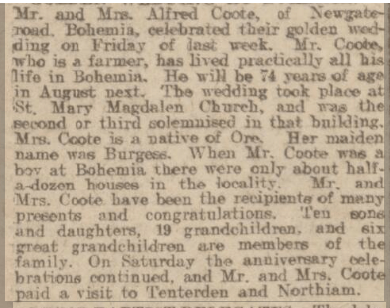
The article helpfully refers to Alfred’s childhood in Bohemia and gives us an insight into how small the settlement was in his boyhood. This would have been Edward and Sophia’s life in the 1830s.
AUTHOR’S THOUGHTS
When initially looking at Edward’s details, I was not sure how much I would be able to find out about his story, as I had to rely heavily on parish records. However, I managed to uncover an interesting story about a man who lived a long and full life, working hard and raising a large seemingly healthy family with only one child dying in infancy.
Edward surprisingly moved about the county quite a lot from East to West Sussex along the South Downs and the High Weald.
This is an artist’s impression of Edward’s movements around Sussex, showing the railway links of the 1840s. It is not to scale.
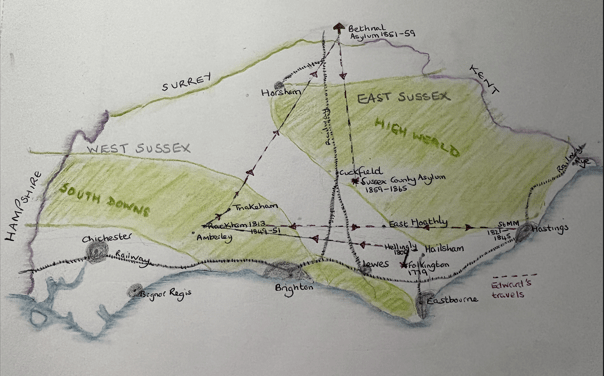
In Edward’s day, farm workers were hired at fairs held in market towns in September or October. This was how they found employment. A worker would wear an emblem to signify their trade. A shepherd would wear a piece of wool in their buttonhole. If an employer was impressed with your work experience, an agreement would be reached regarding pay, and you would be hired. This might explain why Edward and his family moved around Sussex.
Edward seemed to settle in the Bohemia area of Hastings, which was quiet and rural at the time, but between 1845 and 1849 Edward and Sophia moved back to Rackham, a village that was familiar to them.
What led them to move from the Hastings area, and away from Edward’s family, is a mystery. By the time Sophia sadly died it was clear Edward was already struggling. He was on his own, a confused elderly man with no support. The thought of Edward being sent to Bethnal House sounds so frightening and harsh to me, but this was how things were dealt with at that time. As we have seen, this was the only option available to them.
I do feel some relief and thankfulness that Edward was able to return to Sussex and be cared for at the new County Asylum, which was being run by a kind man who believed in caring for his patients in a humane way. I hope that Edward was well enough to enjoy the good food and, most of all, to feel the Sussex sun and breeze on his face once more.
Author: Linda Miles-Cartwright
 Sussex Asylums Burial Grounds Project
Leave a comment