Author: Linda Martin
George Aquila Dubbin
Born: 10th May 1840
Died: 5th January 1890
George’s parents
George’s father Thomas was born in Shoreham on the coast, approximately 6 miles east of Brighton, on 8th February 1803. This information was from his baptism record which took place at Countess of Huntingdon Chapel, New Shoreham on 18th April 1803. His parents were Thomas and Anna Dubbin.
Thomas married Mary Bundy in Brighton at St Nicholas Church, Brighton, on 27th September 1824. On the same day in the same church, Priscilla Dubbin married a George Harvey. Was this Thomas’s sister?
Mary Bundy was the daughter of Daniel Bundy and Alice Cox, born on 24th Dec 1804 and baptised on 3rd November 1811 in the Countess of Huntingdon Connexion Chapel, North Street, Brighton, along with her sisters Anne and Maria. Sadly, Maria’s death is recorded in January 1813.
Mary’s sister Anne later married John Dubbin, brother of Thomas, on 3rd October 1827 at St Nicholas Church, Brighton.
The Countess of Huntingdon Connexion had Chapels in the area. This gave a platform for Evangelical preaching. It was founded in 1783 by Selina Hastings who was married to the Earl of Huntingdon.
The Dubbin Family
Thomas and Mary soon started their large family. The children have been found through baptism records from the Wesleyan Methodist Chapel, Dorset Gardens, Brighton, combined with the Government Records Index (GRO) after 1837.
George’s siblings birth dates: Jane 1825, Thomas 1826, George Harvey 1829, Mary Ann 1831, Jesse 1832, Priscilla 1834, Fanny 1836, Elizabeth 1838, Esther 1842, Henry John 1844, Ebenezer Samuel 1846, Samuel 1848, and Frederick Ernest 1851.
Sadly, George Harvey died aged 5 in 1834, and Ebenezer Samuel died aged 2 in 1848.
As with many families of the time, if a child died then another child, subsequently born, was named after them. However, George’s registration and baptism was not a straightforward find.
His birth was registered without a Christian name on the GRO index, giving the mother’s maiden name as Bundy, and on Ancestry the registration is shown as Male Dublin. However, his baptism shows his name is Aquila George Dublin: “(Dubbin) Born on 10th May 1840, baptised on 13th Sep 1840”.

Aquila was an unusual name to me, so I looked it up online. It is Greek for Eagle and the name of a constellation in the Milky Way. Aquila is also mentioned in the New Testament as being the husband of Priscilla.
1841
In the 1841 Census we find the family in Edward Street, Brightelmstone Parish, City of Brighton. Thomas aged 38, a Shoemaker; Mary aged 36. They have 8 children at home: Jane aged 15, Thomas aged 14, Mary aged 10, Jesse aged 9, Priscilla aged 8, Fanny aged 5, Elizabeth aged 3, and George aged 1.
1851
By the time of the 1851 Census, the family is still in Edward Street, and now the Census lists the address as number 40. Thomas is aged 48, boot/shoemaker; Mary aged 46. The older children have left home, except Mary aged 22, who is a dressmaker. Elizabeth aged 12 and George aged 10 remain at home with other children born since the last Census: Esther aged 8, Henry aged 6, and Sam aged 2.
A son named Ebenezer Samuel on his baptism record was born on 25th May 1846. Sadly his death and burial are recorded in March 1848. Later, in July 1848, a son is born and named Samuel, noted above in the Census.
During the 1850s there are several articles in the Brighton newspapers regarding thefts from Thomas Dubbin’s shop and a troublesome apprentice who stole from his employer a few times and absconded – only to return to work and offend again. Interestingly, Thomas gained contracts in the 1850s to supply the Brighton Guardians with boots and received a payment in 1857 for £37 in respect of his contract. We also know that in 1860 he appeared as a member of the jury in a suicide case and was described as “well respected”.
1861
The 1861 Census shows the family moved one block away to 8 St James Street, which was closer to the beach. They shared accommodation with Fanny Stilton aged 42, a basket hat maker; and Louisa Western, a visitor aged 18.
The Census lists Thomas Dubbin(s) aged 57, shoemaker; Mary aged 55, George aged 21, pianoforte tuner; Esther aged 17, a servant; Samuel aged 12, a scholar; and Frederick Ernest aged 9, who had been born since the last census.
1871
Ten years later, the 1871 Census shows that Thomas, Mary, and George had moved a few miles west along the coast to 2, The Drove, Portslade. Thomas aged 68, still a bootmaker; Mary aged 66; and George aged 30. George is also listed as a bootmaker, presumably working with his father. They are living in shared accommodation with a signalman named Samuel Stredwick and his family.
The 1871 Census return was completed on Sunday 2nd April. There is nothing entered in the last column to indicate that there was anything wrong with George, but on the 19th April he is admitted to Sussex Asylum.
George’s Admission Record to Sussex Asylum describes him as a “Bootmaker, Formerly Pianoforte Tuner”, and gives his “Previous Place of Abode” as 2 Station Street, Portslade. (Why is this different from the address given on his father’s Census entry less than 3 weeks before, which was given as 2 The Drove, Portslade? Had they moved house in those 3 weeks?)
The Admission Records also tells us that his “Form of Mental Disorder” was Epileptic Mania. It further tells us that the “Supposed Cause of Insanity” was sunstroke, seeming to imply that his epilepsy was caused by sunstroke. The record also tells us that George’s first attack of epilepsy was when he was 28, only 2 years before his admission to the Sussex Asylum.
1881
The 1881 Census for Sussex Asylum shows George transcribed as “G A D 39, Bootmaker”.

George was to remain in Sussex Asylum until his death there on 5th January 1890, and his Death Certificate tells us that the cause was Epilepsy SM. (When using Google AI to help understand what this means, the response from Google was: “In the context of an old death certificate, the term Epilepsy SM indicates that the death was a direct, acute result of seizure activity or its immediate consequences, as opposed to an unrelated cause.“)

George’s remains were unclaimed, and he was laid to rest as a pauper in the Sussex Asylum burial grounds without a named marker.
The deaths of George’s parents
George’s father Thomas died in 1886. I wonder if George knew of his death. His mother Mary died in the first quarter of 1891.
Epilepsy
It’s not known if George was born with epilepsy or whether it was brought on by a head trauma or infection. If so, it was not noted on any of the census returns. However, George’s Admission Record to Sussex Asylum states under the “Supposed Cause of Insanity” as “Sunstroke”. Google was again asked if there was a possible connection between epilepsy and sunstroke. It gave quite a comprehensive response which is summarised with the statement: “Sunstroke itself does not directly cause epilepsy in the general population, but it is a serious medical event that can cause acute seizures and, in severe cases, be a contributing factor to developing acquired epilepsy.“
George started his career as a piano tuner, maybe taught by his elder sister Jane’s husband. Later he became a bootmaker like his father. This could have been because of his epilepsy. He changed his occupation so he could be watched by his father as he was still living at home until he entered the asylum system. He spent the rest of his 19 years of life there.
James Gardner gives us some idea of what it was like for an epileptic in the Sussex Asylum in his book
Sweet Bells Jangled Out of Tune. The History of the Sussex Lunatic Asylum. (St Francis Hospital) Haywards Heath.
The Asylum Superintendent was Samuel Duckworth Williams from 1870-1888. He was the successor of Robertson 1859-1870.
Two paragraphs taken from page 219:
“As chronic cases were discharged, they were increasingly replaced by epileptic and suicidal patients who needed a lot more supervision. In 1873 after the death of an epileptic patient during the night, the commissioners recommended that all suicide and epileptic cases should be kept in one ward. Williams initially resisted this suggestion arguing that the lumping together of this group of patients could make their condition worse. But by 1878, they were placed in two wards and supervised by four nurses during the night. The wards – consisting of 44 beds, six single rooms and one padded room – were so arranged that the nurses could see the occupant of each bed from every part of the ward.
Williams had a particular interest in Epilepsy and experimented with treatments such as the nitrite of amyl and bromide of potassium which were used to shorten and reduce the number of seizures. Like Robertson, he believed the patients needed a specialist hospital with a lot more supervision, but this facility was scarce. By 1874 there were as many as 78 epileptics at the asylum.”
George’s siblings
As there are so many I have kept this as short as possible so as not to take the attention away from George.
Jane (1825-1876)
Jane married Isaac Jackson, a piano tuner, 29th September 1845. I have found 11 children born to the couple. 3 sons became pianoforte tuners and Arthur Herbert Jackson, who was born in 1851, studied music and became a composer. You can find his story on Wikipedia; he composed orchestral music as well as piano and choral. Sadly, he died of Tuberculosis Meningitis at the age of 29. I couldn’t find any images for him. As stated previously, it may have been Jane’s husband that helped George become a pianoforte tuner in his early life.
Thomas (1826-1881)
Thomas followed his father into becoming a shoe and boot maker. He married Emma Sone in Brighton on 6th October 1850. The couple moved to London and had 11 children. By the time of the 1881 Census Thomas was in the Shoreditch Infirmary. His death was registered in the fourth quarter of 1881.
George Harvey (1829-1834)
George died aged 5.
Mary Ann (1831-?)
Mary married Paul Stanislas Bocquee on 21st July 1856 in Brighton. Paul was born a British subject in Mauritius, and at the time of his marriage his occupation was recorded as a Student of Law. I found a daughter Leoneda Hortense Mary, born in 1857, and a son’s death in 1858. In 1861 the family was living at 43 John Street, St Pancras, London, in shared accommodation; no occupation was recorded for Paul. I have no other information on the family.
Jesse (1832-1920)
Jesse, who was also a bootmaker, married Harriett Short in 1856, and they had a son Jesse. Harriett died in 1862. In 1868 Jesse got married for the second time to Lucy Short of Warwickshire, a possible relation of Harriett. They had a son Sidney. There are photos of the family on Ancestry family trees.
Priscilla (1834-1906)
In 1851 Priscilla, a servant, was living with her sister Jane and husband. On 2nd May 1854, Priscilla baptised a son Frederick Eugene Dubbin in Brighton. No father was recorded. Sadly, Frederick’s death is registered in the second quarter of 1854. Priscilla went on to marry John James Luffman, a mercantile clerk, on 8th January 1855. Both were minors. By the time of the 1861 Census Priscilla was not with John J Luffman; instead she was living with John Cox, a younger man and brass finisher, in Deptford. Her age is given as 21, which was not correct as she was 27 years old. There is a death of a John Luffman in 1868, the same year that Priscilla marries John Cox, so I am assuming that Luffman’s death is correct.
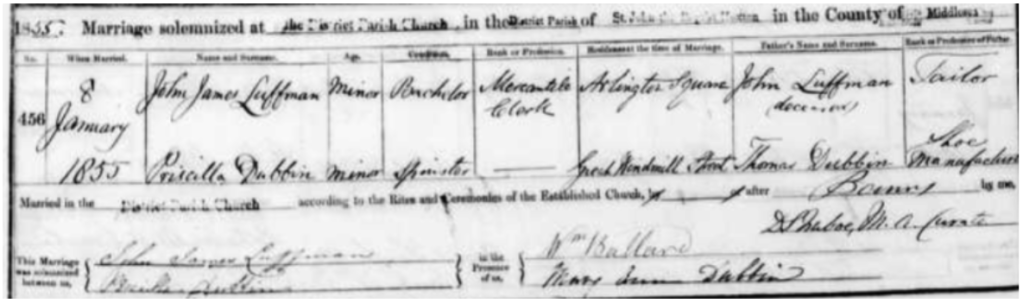
Luffman and Dubbin marriage certificate.
I haven’t found any children born to Priscilla from these marriages.
In the 1891 Census, I found Priscilla married and living with her widowed sister Fanny. Both their ages are incorrect. No mention of John Cox. Family trees indicate that Priscilla died in 1906. However, this Priscilla was 84 at time of death which is too old for Priscilla, especially as her birth is recorded around 1840. There is a possible death in Camberwell 1904, with the deceased listed as aged 65. This is the closest I can find.
Fanny (1835-1905)
In 1858 Fanny married James Zephaniah Jutting, a tailor, in Brighton. They moved to London and had a family. James died in 1870 leaving Fanny with four young children. Two had died as infants before James’s death. I found two entries where Fanny had been admitted into the Workhouse. In 1887 she was in Westminster Workhouse and on 14th October 1895 she spent 3 months in Stepney Workhouse. The notes state she had been ill for 10 months with “general debility”. By 1891 she was with her sister Priscilla, living on her own means. On 28th March 1905 Fanny was admitted to Fisherton House, a private asylum in Wiltshire, and she died less than 2 months later on 18th May 1905. The cause of death listed on her certificate is heart disease and syncope (lack of blood to the brain).
Fanny’s youngest son was twice married. James William Jutting 1868-1941 was married in 1892 and 1899. In 1904 James was admitted to Wandsworth Asylum. He was transferred to Oxford in 1910 and transferred again to Napsbury Asylum St Albans in 1912, where sadly he lived until his death in 1941. I have checked the unindexed London Poor Law records on Ancestry for 1904, but I am unable to find any record of his admission to Wandsworth.
Elizabeth Ann (1838-1925)
Elizabeth married James Chappell Williams in Brighton in 1867. James was a printer born in Jamaica. They had a family and lived in London. A family tree online shows many family photographs. Elizabeth died in Deptford in 1925.
Esther (1843-1890)
Esther married a soldier, Sergeant William Allen in Brighton 1870. They were stationed in Aldershot in 1871, and then moved to Halifax in West Yorkshire where Esther died in 1890. No children found.
Henry John (1844-1925)
Henry married Anne ‘Phoebe’ Parratt in Hove in 1867. Henry was a baker. However, he later changed his occupation and became a shoemaker like his father. The Census returns show they lived with their family in 8 Lower Market Street, Hove, from 1871-1901. In 1901 Henry seems to be working as a baker again. By 1911 Henry was in Kensington Infirmary in London and Anne was a visitor with their daughter Lilly and family in St Georges, Hanover Square, London. Maybe Henry was taken ill there. Anne is living with Lily and her family in the 1921 Census and her death is registered in Hanover Square 1924. In the 1921 Census Henry is in Steyning Union Workhouse, 2 Upper Shoreham Road, Kingston by Sea. His death is registered in Steyning in 1925.
Ebenezer Samuel (1846-1848)
Ebenezer sadly died 2 months before his second birthday in 1848 in Brighton.
Samuel (1848-1941)
Samuel married Rhoda Susannah Moss, a certified schoolmistress, in Stanmer on 5th June 1876. Samuel was an ironmonger’s assistant and they had 2 children. In 1901 they were living in the National School House, Falmer, Newhaven where Rhoda was the schoolmistress. Rhoda died in 1924 and Samuel lived to the grand age of 93. In the 1939 register he is living in Eventide Nursing home in Cuckfield. Again, there are lovely family photographs on an online family tree.
Frederick Ernest (1852-1939)
Lastly, Frederick, who married Mary Ann Funnell on 21st June 1869 in Preston, Sussex. Four children were found to this marriage. Sadly, Mary died in 1880 aged 28. Frederick married for the second time on 27th August 1881 to Lois Ann Long. The 1911 Census states 3 children were born to the couple but one died.
Frederick’s occupation changed from bootmaker to house painter and back again, possibly his chances of work were increased by his flexibility.
Frederick died aged 89 while in a Salvation Army nursing home, The Villa Adastra, Hassocks Cuckfield. The cause of death was listed as myocardial degeneration (degeneration of the heart tissue.)

AUTHOR’S THOUGHTS
George was born into a large hard-working family. He started his career as a pianoforte tuner; he would later change occupation to become a bootmaker like his father. Was this due to his epilepsy – ensuring he could be close to his father and remain in the family home to be safe and constantly supervised?
By 1871 George’s parents, now in their late 60s, most likely found it hard to care for George. Maybe none of his siblings were able to care for him either, not knowing how debilitating his seizures had become. I imagine the only option open to them at the time was the Workhouse or the asylum system for an epileptic.
Sadly, George was to spend 19 years in Sussex Asylum which wasn’t the best care for Epilepsy, but there wasn’t anything better at the time.
Potassium Bromide and Nitrite of Amyl were used to reduce seizures. Phenobarbitals were not brought into use until 1912, and modern ASDs (Anti Seizure Drugs) were to follow. Epilepsy colonies came into being at the end of the 19th century. All too late for George.
The National Society for Employment of Epileptics (NSEE) was launched in 1892 by a group of London philanthropists and medical men. In 1894 the first colony opened (for men) in Skippings Farm, near Chalfont St Peter, Buckinghamshire, and it cost 10 shillings per patient per week. The women’s side was opened some years later. The epilepsy colonies were based on the theory that an outdoor life with intellectual and physical activities were, according to Sir William Broadbent, a “very great help in the restoration of the nervous equilibrium, and the occasional cure of the disease.”
Without the Sussex Asylum visitors’ book it’s not known if the family stayed in touch with George. Did he know of his father’s death? His mother died a year after George, and it seems the family, for whatever reason, were unable to have a private burial for him. Therefore, sadly George was buried in a pauper’s grave in the Sussex Asylum burial ground, unnamed and to this day unmarked. The burial ground is not far from the main entrance to The Princess Royal Hospital, Haywards Heath, Sussex.
Author: Linda Martin
 Sussex Asylums Burial Grounds Project
Leave a comment