Author: Linda Martin
Emery Churcher Clayton
Born: 1820, Selsey, West Sussex
Died: 24th September 1870, The Sussex Asylum (St. Francis Hospital)
Buried: 28th September 1870
Emery son of a Yeoman Farmer of Selsey
Selsey also known as Selsey Bill or Seal Island sits on the Manhood Peninsula 8 miles south of Chichester. Over- looking the English Channel to the east and south of the point and to the west the entrance to the Solent, a busy shipping lane for the Portsmouth and Southhampton docks. With views across to the Isle of Wight. It’s still known for its arable land now largely lettuce and some potato growing. Much of the land has been lost to sea erosion which is an ongoing problem. Approximately a mile out to the sea is the Mixon reef, a limestone outcrop said to have been quarried from Roman times. Many a yacht has fallen foul in the area and been rescued by the Lifeboat which has been part of Selsey since 1861. Selsey is also known for its Crab and Lobster fishing, the occasional visit from Seals and not forgetting the smugglers of the 14th century.
Glynn House, High Street, Selsey, home of the Clayton Family.
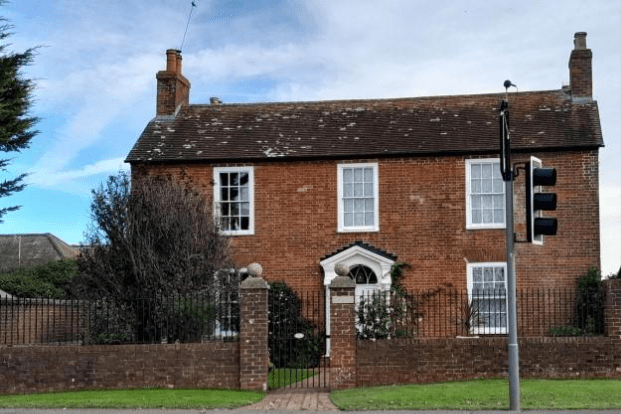
Image 2025, Grade II listed
Emery was the second son born to William Clayton and Emily Churcher Wedge. He was baptised in the local parish church on 6 August 1820. William’s occupation was recorded noted as a Publican.
Emery’s baptism below.

Emery’s father William was born in Selsey and was also baptised at the parish church on 6 April 1796, son of Matthew 1757-1831, and Elizabeth Clayton nee Duke.
Matthew’s father James, 1724-1811 was from West Wittering, a settlement west of Selsey. He married Mary Reeves, 1732-1800. She was from Selsey and this was where the couple settled and had 6 children. Matthew was one of them, he was Emery’s Grandfather and father of William.
William married Emily Churcher Wedge in the parish church on 26 February 1816. There is some confusion as to the parents of Emily. Family trees show her as the illegitimate daughter of Ann Wedge from the neighbouring village of Sidlesham. There is a baptism document which is only a transcription on Ancestry, however, when looking at the actual document the name “Emley Churcher” is listed as “Son of Ann Wedge”. The baptism date is 21 April 1799. It’s possibly Emily Churcher. Ann Wedge has more 3 more children Daniel, Mary Ann, and Charlotte.
There is also a married couple William and Ann Wedge in Sidlesham but they have moved or died before the 1841 census. I am unable to track them, or find an Emily baptised to this family. I found a marriage of an Ann Wedge in Sidlesham on 6 May 1811 to James Osgood. Could this be her or the possible widow of William. Two daughters were born to the couple. I found a James Osgood in the 1841 census age 70 living in Selsey but no wife, so I am thinking Ann has died.
There are also Churcher families in Chichester and surrounding villages all with similar Christian names including Emery. It’s a mystery.

The Clayton Family
William and Emily had a large family with their first born a son William baptised in 1817 and then followed by Emery in 1820.
Their Siblings:
Walter, Kester, Lavinia, Emily, Matthew Thomas, Jane Carr, Adeline, Henry Lane, Mary Jane, Frances Augusta, Sarah Ann and Catherine Harriet. A total of 14 children found by their baptisms.
The baptisms of the children show William is a Publican until 1831. The only public houses found in Selsey in the early 1800’s are, The Crown Inn, which is on the same road as Glynn House, or The Albion which is now the Lifeboat Inn. It is situated close to the working fishermen’s beach east of the point. By 1833 William is a Farmer.
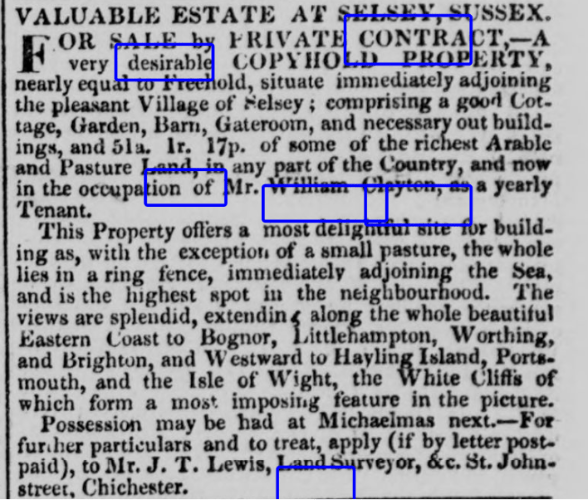
The advertisement from the Hampshire Telegraph of 1836 shows William is a yearly tenant of farmland in Selsey described as ‘Some of the richest Arable and Pastureland in any part of the country’.
From the description below the land is at the most southerly point of Selsey and now some of the land may be lost to sea erosion.
The 1840s and 50s
The 1841 census shows the family in Selsey Street, (now known as the High Street) possibly in Glynn House,
William aged 45, a Farmer, Emily his wife aged 40, Emery aged 20, no occupation. Walter aged 20, a Surveyor’s Apprentice, Kester aged 15, the Navy, Matthew aged 10, Henry aged 4, Lavinia aged 15, Emily aged 13, Adeline aged 6, Mary aged 2, Sarah and Frances (Twins) aged 6 months. William’s mother Elizabeth Clayton aged 80.
The 1851 Census shows no number or house name just High Street, William aged 55, Farmer of 4 acres, born in Selsey, Emily aged 52, wife born Sidlesham, Kester aged 26, a Sailor. Lavinia aged 24, Emery aged 30 no occupation, Adeline aged 17, Henry aged 14 a sailor, Mary aged 12, a Scholar, Catherine aged 5, a scholar. All children were born in Selsey.
Emery’s health
The Last column on the census to indicate lunacy etc, has been left blank. However sadly, later in 1851 Emery enters the County Asylum system. Neither the 1841 nor 1851 census indicate that Emery was in employment which could possibly suggest that Emery was unable to work.
On 23 October Emery was admitted into Bethnal House in Bethnal Green, London. Fortunately for Emery by 1851 Bethnal House, known as the “Mad House”, was classed as one of the better run Asylums. It had in the past had a terrible reputation. See the article here (with thanks to The Lost Hospitals of London web site) https://www.ezitis.myzen.co.uk/bethnalhouse.html
Sussex Asylum in Wivelsfield near Haywards Heath was opened in July 1859, it was later known as St Francis Hospital. Emery was transferred here on 5 August 1859. Emery would have been one of its first patients.
Lunacy Register entries found.



The 1861 census shows Emery is still a patient at Sussex Asylum recorded as E C C . son of Farmer.

Emery was to live 19 years in the County Asylum system, he tragically passed away on 24 September 1870 aged 50 due to accidental poisoning, 7 hours after consuming yew tree berries. The stone at the centre of the berry being highly toxic.
The details of the inquest can be found in the Surrey Gazette dated 31 October 1870. The transcript is below.
“DEATH FROM EATING YEW BERRIES„—On Tuesday L. G Fullugar Esq. Coroner, held an inquest at the County Asylum touching the death of Emery Churcher Clayton. The first witness called was Mr Patrick Nicol Assistant Medical Officer at the asylum, who deposed that the deceased was described on his reception as a Farmer’s son, aged 31 years and was removed from Bethnal-Green asylum to this asylum in July 1859. Was called to see him on Saturday afternoon about 5 o’clock, from the report that he had been found dead. When witness saw him, he was sitting on a form much in his usual way, but quite dead; the body was warm. Witness made a postmortem examination on Sunday and found a number of red berries, partly digested. Where the berries were most numerous there were most signs of inflammation. The berries were found to be identical with those growing on the yew trees in the asylum cemetery, From his examination he was of opinion that the man died from swallowing a large number of yew berries, and this opinion he grounded on the known poisonous effects of these berries when digested on an empty stomach in considerable quantity, and in the state of the viscera of the deceased which was that likely to follow digestion of a poison of a class to which the yew belongs. Witness observed nothing wrong with him but was afterwards told that be had sickness and vomiting at dinner. It did not follow that the attendant must have been inattentive not to have noticed that he was ill. Deceased was a very gluttonous man. Some patients were apt to eat anything that had the slightest appearance of being edible. Deceased was at work at the cemetery on Saturday morning near the yew trees. His sickness on Saturday was attributed to his having eaten a very large dinner. Timothy Cottrell a Day Attendant—spoke to deceased being sick which he attributed to his eating so much at dinner. George Wren another attendant noticed deceased gathering berries off the yew tree; and had him away from them. The trees were all round the place where deceased and eight other patients were working. He did not appear to be ill. Had no orders to prevent the patients gathering the berries, but thought they would do them no good, and therefore ordered the deceased away, A verdict in accordance with Dr. Nicoll’s evidence was returned by the jury. “

Emery was laid to rest on 28 October in the asylum graveyard. In an unmarked grave.
Emery’s parents
Willam and Emily out lived possibly 8 of their 14 children. The 1861 and 1871 census shows them still residing in the high street in Selsey.
Emily died in 1877 and was buried on 3 July.
The 1881 census ‘in the village’, William aged 85 a retired farmer, daughter Catherine aged 36, and Jane Tripcony a domestic servant from the Isle of Wight.
William died on 22 May 1882 and buried on 27 May.
William’s will below.

Emery’s siblings
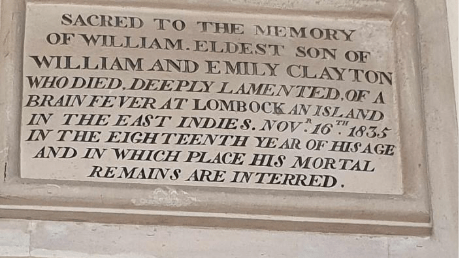
William, born in 1817 died on 16 November 1835 aged 18, he was a sailor, and died from brain fever in Lombock, East Indies. This is now modern-day Indonesia and is where his remains are interred. There is a plaque dedicated to him in the Chapel at St Wilfrid’s cemetery, Church Norton, Selsey burial grounds.
Walter, born in 1822 who died in 1857 aged 35. Walter was a surveyor and sadly he accidently drowned in Australia, the inquest took place on 19 Feb 1857 in Port Macquarie. He was married in Australia to Helen Felton and had two daughters.
Below a short introduction to the lengthy report on the accident showing Walter was well respected in Selsey. Drowned during a storm.
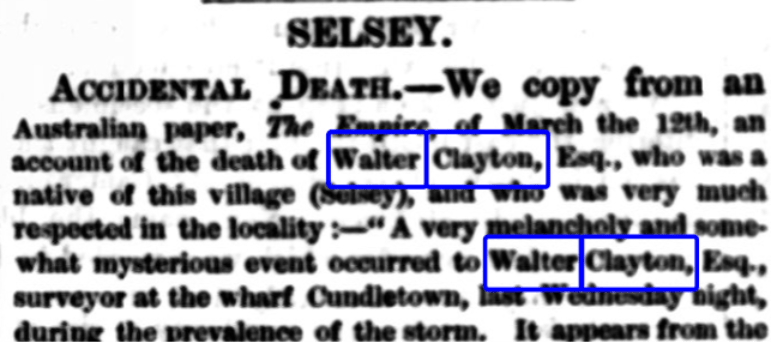
25 June 1857 West Sussex Gazette.
Kester who was born in 1824 possibly died between1856-1861 in his early 20’s. Kester married Eliza Isabel Taylor in London in 1854, he was a sailor having achieved his master certificate in June 1851. Kester gave evidence at an Inquest held in 1856 in Folkstone whilst he was Chief Officer of the ship “Josephine Willis” which was hit by a steamer off Folkstone whilst on route to New Zealand. There are plenty of lengthy newspaper reports of the incident, too many to add here. The jury found Richard Bourchier guilty of manslaughter

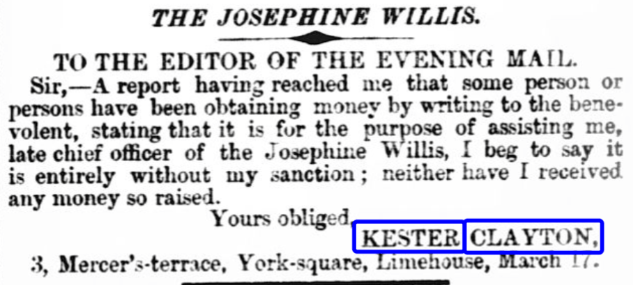
London Evening Mail – 19th March 1856.
I cannot find the death of Kester, however in the 1861 census Eliza is recorded as a widow, she is a housekeeper to Henry Gardner a landowner in Chipping Norton, Oxon.
Lavinia Georgina born in 1826 never married and remained a spinster working as a Governess. She outlived her parents. The 1871 census shows her living in Hampstead, by 1881 she was at Bramcote Hall in Nottingham. The 1891 census shows she is a Visitor in Hampstead, London. From the 1899 Electoral Register we find she has retired back to Glynn house, Selsey.
On 21 June 1905 Lavinia benefited from the will of her old employer Mr Smith of Bramcote Hall, leaving her £50 per Annum. In 1911 Lavinia was in a private nursing home in Highgate, with only two patients on census, she died on 1 October 1913.
Emily born in 1828. She was also employed as a Governess. In 1851 we find her employed in Nyton House in Westergate approximately 13 miles north of Selsey and to the east of Chichester, the house is now a nursing home. In 1861 Emily has moved away and is now Governess to the family of The Honourable Alexander Leslie Melville in The Hall, Branston, Lincolnshire. I am unable to positively identify Emily after this.
Many family trees record her as Emma G Clayton who died in 1919 in a convent in France. I do not think this is correct. Ancestry in the 1851 census incorrectly transcribes Lavinia G as Emma G Clayton.
Matthew Thomas born on 29 June 1831, gained his Master’s Certificate in the Merchant Navy on the 4 August 1853. In 1860 he wed Mary Ellen Newton in Selsey. Mary was a Norfolk girl.
There is a large, detailed family tree with Photographs on Ancestry showing the family settled in New Zealand. The couple had 10 children. Captain Matthew Thomas was also a skilled Marine artist. He died on 30 April 1922 aged 90 just weeks after his wife Mary 17 March 1922 aged 89. They are buried in St Davids Cemetery, Wiri, Auckland. Sadly, also in the grave is William Thomas Emery Clayton their grandson aged 9 years who died in 1920.
Matthew’s story and Artwork can be found online. The Cyclopedia of New Zealand 1897-1906 shows his photograph and life story to that date. He is reported as a Surveyor of Lloyds register and general Shipping Agent. Also, a family tree has Matthews sketches of his parents.
Jane Carr born in 1833. Tragically, Jane only survived for 9 weeks.
Adeline was born in 1834, and in 1851 Adeline was living at home with her parents aged 17, no occupation. She married Emery James Churcher on 30 October 1858 at St Peter’s Walworth. He was a distant relation. Churcher being a part of her mother’s name and the name Emery had been passed down the Churcher family. Adeline and Emery had 9 children and by the 1911 census 7 of those children had died. Emery was a civil servant in India. He died in 1916, Adeline died in 1921 at the home of their son Douglas Wilfred Churcher a retired Army officer, residing in Arborfield Grange, near Reading.
Henry Lane was born in 1836. In 1851 Henry is with the family. On 3 January 1866, Henry received his certificate of Master in the Merchant Navy. A newspaper article reports his marriage to Margarita Craig on 20 January 1875 in Valparaiso Chile. Henry now employed by the Pacific Steam Navigation Company, a commercial shipping company, carrying mail and sailing along the coast of Chile, Henry was the commander of SS Callao. The couple had a daughter Lilian Margarita but I cannot find any further information on Henry and his family.
Mary Jane born in 1839, can be found in the 1851 census with the family. In 1861 she was a Governess in Yalding Kent. On 2 October 1862 in Selsey Mary married George Pile a Chemist from Bexley in Kent. By 1871 the couple can be found in North Street, Chichester, George is continuing in his employment as a Chemist with wife Mary. Sadly, George died in 1878. In the 1881 census Mary is a visitor at the home of Stephen Cannon a Corn Miller in Bexley, Kent. After this I cannot trace her in the census returns. Some Family trees show Mary Pile in Long Grove Asylum and death there in 1913. However, I have found Mary Pyle death in 1925, burial in St Wilfrid’s Church Norton where the Clayton family are buried. Her address is given as West Street, Selsey, she is not living there in 1921. No children found from this marriage.
Sarah Ann and Frances Augusta were twins born in 1840. In the 1841 census the girls are 6 months old, then on 9 June 1841, Frances died and was buried on 13 June. If that was not heart breaking enough twin sister Sarah died two weeks later on the 22 June and was buried on 27 June, both from Whooping Cough, Frances and Sarah’s deaths were registered by Lucy Woodland a nurse residing further along Selsey Street.
Catherine Harriet (Katherine) born in 1845, baptised as Catherine Harriet, later records spell her name Katherine.
The 1851, 1861, and 1871 Census’s show Katherine is at home with her parents. In 1881 William is now a widower and retired farmer. Katherine 36 and single, they have one servant. I have been unable to trace her in the 1891 census. In 1901 Katherine is still in Glynn House now with her sister Lavinia with one domestic servant. In 1911 Katherine of independent means is now head of Glynn House with 3 domestic staff and a visitor, Sarah Riverie a widow. In the 1921 census Katherine is now aged 76, a single independent woman. Visitors to her house are Archibald Clarke-Kennedy, 40 a clerk of Holy orders from Wroughton, Swindon Wiltshire. His wife and two children and his 3 staff, a cook, parlour maid and children’s nurse.
On 15 November 1929 Katherine died at the Vicarage in Highworth, Swindon and she is buried in St Wilfrid’s cemetery Church Norton with her parents.
St Wilfrid’s Chapel & Cemetery – St Peter’s Church, Selsey, Parish Church:
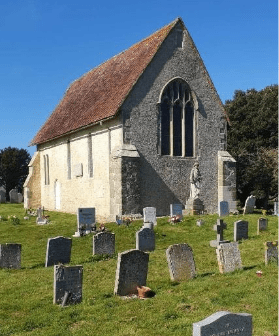
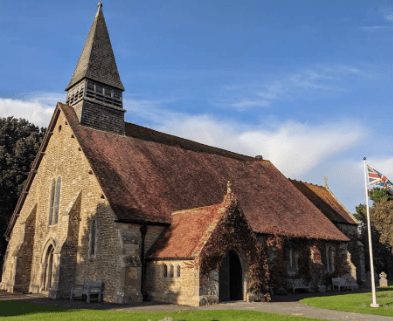
The parish church was situated at Church Norton about 2 miles north from the present church.
In 1860’s the 13-century church was moved stone by stone to its present-day position in the High Street, Selsey. It was consecrated in 1866. The chancel was left behind and in 1917 it was named St Wilfrid’s Chapel after St Wilfrid who landed at Selsey to preach Christianity to the south Saxons. It’s said that the church was situated on the site of St Wilfrid’s Cathedral/Monastery which he built in 680—686. It was later left due to sea erosion and the Cathedral in Chichester was the replacement in 1075. The site also has remains of a Norman settlement from when they landed on the south coast at Pevensey and travelled along the south coast.
After a long search of the gravestones I only found later generations of Clayton’s, descendants of James Clayton, Emery’s father William’s cousin, who resided in High House, West Street, Selsey who was also a yeoman famer who farmed over 100 acres, I believe to the west of the village. There is also a Clayton Road which runs from West Street to Hillfield Road which follows on from the High Street to the point. There were many old gravestones placed around the perimeter and tombs covered in ivy all illegible. Most likely there are memorials to the Clayton family amongst these stones.
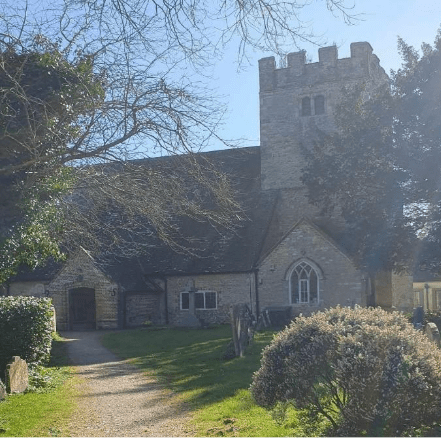
The 12th century church of St Mary’s, Sidlesham which I visited to see if I could find any graves Churcher or Wedge, but again all the old graves were illegible. An old map in the church showed family names but again sadly no Churcher or Wedge.
Author’s Thoughts
Emery came for a large and seemingly well-educated family. No occupation is given to him unlike his brothers. Most of the boys were Master sailors in the Merchant Navy and Surveyors. The girls became Governesses. Without medical notes it’s inappropriate to speculate why Emery found himself in the Asylum system. Did his family give up on him? His parents were still alive when he died but his body was not brought back to Selsey but buried sadly in a pauper grave in the Sussex Asylum grounds, again we cannot speculate as to the reason why. He didn’t enter Bethnal House until the age of 31 so he had over half his life in the family home. It’s a shame there were no local Asylums in the area at that time, Graylingwell Hospital in Chichester didn’t open until 1897.
His family has been very interesting to follow, and I have on purpose tried to keep their stories short so as not take the focus off Emery. Yew tree berries, I was unaware how toxic they are. The flesh is edible but the stone/seed in the middle is highly toxic. I was surprised that many died by accident by being tempted by these berries including Emery himself in what seems such an unusual death. The inquest suggests that he must have thought the berries looked very tempting and by the time he had been spotted eating them it was too late. He was buried in the very same cemetery on which he had been working, surrounded by the trees bearing the berries that killed him.

 Sussex Asylums Burial Grounds Project
Leave a comment